

How to stop feeling behind and see your own progress this week
You are not behind. You are looking at the wrong scoreboard.
You scroll for two minutes and see a friend with a promotion, a new apartment, or a side business taking off. Then you feel a little smaller, and your own momentum stalls.
You stop feeling behind when you measure this week against your own last week, not against someone else’s highlights. This works because comparing drains confidence, while seeing your own small wins rebuilds it. Being clear about one number you control is personal growth you can feel by Sunday night.
Below, you will see what research says about comparing yourself online, why visible progress matters, five steps to build your own scoreboard, and a three-line template you can use this week.
Why does scrolling make you feel behind?
Scrolling makes you feel behind because you compare your whole messy week to other people’s best moments. The feed shows finished wins and hides the slow middle, so the gap looks bigger than it is.
Researchers have tested this. In a 2014 paper in Psychology of Popular Media Culture, Erin Vogel and colleagues ran an experiment where people viewed a social media profile. Those who saw a profile with upward comparison cues, such as a very active network and healthy habits, reported lower state self-esteem than those who saw a profile with downward comparison cues. State self-esteem means how you feel about yourself in that moment. Vogel and colleagues’ 2014 study
The same paper also included a survey study. People who used Facebook more often tended to have lower self-esteem overall, and more exposure to upward comparison partly explained that link. A survey shows a pattern, not a cause, but the experiment points the same way.
You will not get to zero comparisons. The goal is to give yourself a better scoreboard to look at next.
Why does tracking your own progress help more?
Tracking your own progress helps because progress you can see gives you energy to keep going. Researchers Teresa Amabile and Steven Kramer collected about 12,000 diary entries from 238 professionals on 26 project teams in seven companies. They found that making progress toward meaningful work was the strongest factor behind a good inner work life, which is how people think and feel about their work. Amabile and Kramer’s progress research, summarized by ATD
That was a study of people at work, so it does not prove the same result for a side project or a job search. But the idea carries over. You feel steadier when you can see that you moved, even a little. Over time, that steadiness is how resilience and confidence get built.
A pattern I see in young professionals
Many young professionals I talk to are doing more than they give themselves credit for. They changed jobs, started a side project, or got a handle on a hard month.
But they judge themselves against a friend who is two years ahead. The progress is real. It just does not show up on the scoreboard they are using.
Being clear about what you are measuring changes how the week feels. A vague sense of “I am not where I should be” has no finish line. One number does.
How do you stop feeling behind and see your own progress?
You stop feeling behind by choosing one number you control and comparing it only to your own last week. Use these five steps.
Pick one number you control, such as applications sent, workouts finished, or pages written.
Write down last week’s number, even if it is zero.
Set this week’s target one step higher, not ten steps higher.
Do one 20-minute step on it before the week gets busy.
On Sunday, write both numbers side by side and compare them to each other only.
Here is how it looks. You want a better job, so your number is applications sent. Last week: one. This week’s target: two. On Tuesday at 7pm you spend 20 minutes on the second one. On Sunday you write “2” next to “1.”
You did not catch up to anyone. You did move, and now you can see it.
Each small number is proof. Proof is how you build confidence, and it is how you keep momentum on a week when everything else feels slow. That is personal growth you can point to, not just a feeling.
If your energy is low after work, pair the step with one 20-minute move after work. If you cannot decide which number to track, take one small step before you feel ready and pick the easiest one.
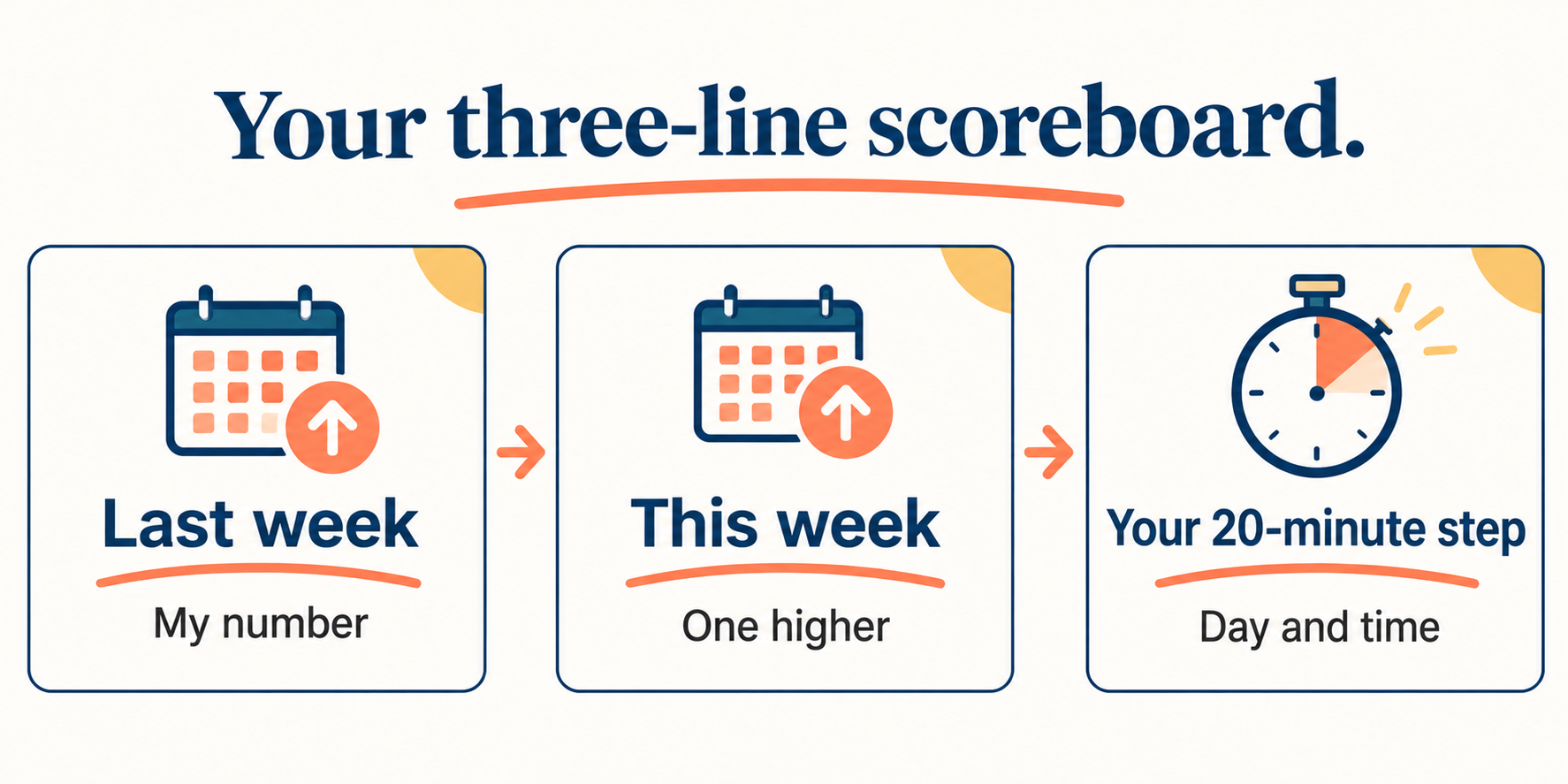
Your three-line scoreboard
Copy this into your notes app or onto a sticky note. Each line is one short sentence, so it takes five minutes.
Last week my number was: ___
This week my number is: ___ (one higher)
My 20-minute step is: ___ (day and time)
Metric: three lines, five minutes, one number.
FAQs: feeling behind
Q: How do I stop comparing myself to other people? A: You will not stop completely, so make the comparison smaller. Mute or unfollow accounts that leave you feeling behind, then check your own number once a week. Your last week is the only fair comparison.
Q: What if my number did not go up this week? A: Treat a flat week as information, not failure. Shrink the step and try again. If you stalled for a few days, here is how to restart without starting over.
Q: Is feeling behind the same as depression? A: Not always. Many people feel behind now and then. If low mood or worry lasts most days, talk with a licensed professional. This post is education, not medical advice.
Try this before you close the tab
Which friend or account makes me feel behind the fastest?
What is one number I control that I could track for the next seven days?
What day and time will I do my first 20-minute step?
If you have a long list of ideas and nothing finished, pick one idea and make it a first step works the same way.
Your next step
There’s a full 7-day confidence checklist inside the free guide with step-by-step instructions on how to use it.
You are not behind. You are on your own path, and one number can show you that today.
I Believe In Your Greatness. Your Path To Limitless Growth!