
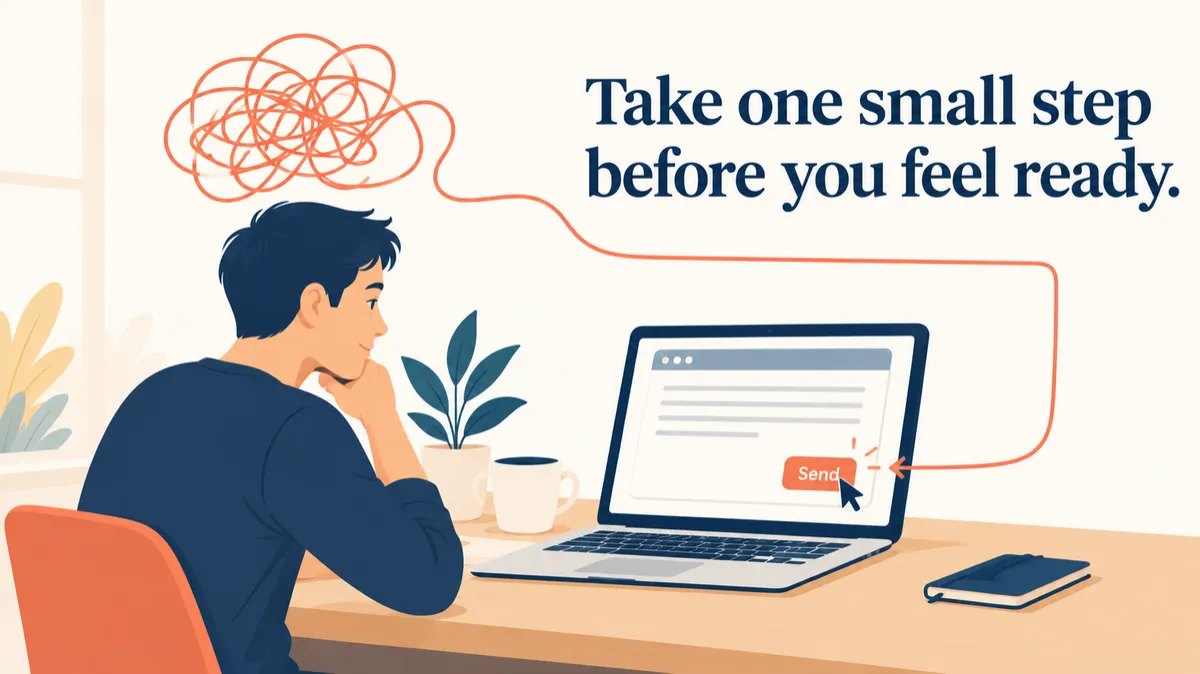
Stop overthinking. Take one small step before you feel ready.
You have read the same message five times. You have opened ten tabs about one decision. Nothing has moved.
That is overthinking, and it feels like work. It is not progress.
You stop overthinking when you take one small, low-risk step before you feel ready. This works because confidence comes from what you do, not from what you think. Psychologist Albert Bandura listed performance accomplishments, meaning times you tried something and it worked, as one of four main sources of self-efficacy, your belief that you can handle a task. “Bandura’s 1977 paper on self-efficacy”
Below, you will see why thinking harder backfires, five steps to get moving, and three first steps you can copy tonight. Being clear about one small step is personal growth you can feel by the end of the day.
Why does thinking harder make the decision feel bigger?
Thinking harder makes a decision feel bigger because every extra option adds pressure to choose perfectly. More choices do not make you safer. They make the start line feel farther away.
Psychologists Sheena Iyengar and Mark Lepper tested this at a grocery store jam table. Of the shoppers who stopped to taste, only 3% bought jam when 24 flavors were out. About 30% bought when 6 flavors were out (Journal of Personality and Social Psychology, 2000). “Iyengar and Lepper jam study”
Researchers call this choice overload, the stall that happens when too many options make choosing feel risky. Your career, your money, and your side project all have more options than you can compare. That is the same pattern behind needing fewer decisions instead of more willpower.
What does waiting to feel confident cost you?
Waiting to feel confident costs you time, because confidence usually shows up after the action, not before it. Bandura wrote that the more dependable your own experiences are, the more your belief in yourself changes. Each small win is a data point.
There is also a cost to needing the perfect answer. In 2002, Barry Schwartz and his team studied maximizers, people who feel they must find the single best option. Across seven samples, maximizing was linked to lower happiness, optimism, and life satisfaction, and to more regret, depression, and perfectionism. “Schwartz and colleagues’ 2002 maximizing study”
Those are correlations, so they do not prove that overthinking causes unhappiness. But the pattern is worth noticing.
A pattern I see in young professionals
Many young professionals wait for a sign. They want to feel sure before they send the email, ask for the meeting, or start the project.
The sure feeling rarely comes first. What changes it is one small step that goes fine.
How do you take a small step before you feel ready?
You take a small step by shrinking the decision to one action you can finish in ten minutes, then doing it today. Use these five steps.
Write the decision in one sentence.
Ask: what is the smallest step I could undo tomorrow?
Set a ten-minute timer and pick a time today to start.
Do the step before you collect one more opinion.
Write one line about what happened, then choose your next step.
Here is how it looks. The decision: “Should I apply for the analyst role?” The smallest step you could undo: open the application and fill in your name and work history. The timer: ten minutes, starting at 7pm tonight. You are not deciding to take the job. You are only deciding to begin.
If your energy is low after work, pair the step with one 20-minute move after work.
A step that goes fine becomes proof. Proof is how confidence and resilience stack up, and it is how momentum starts.
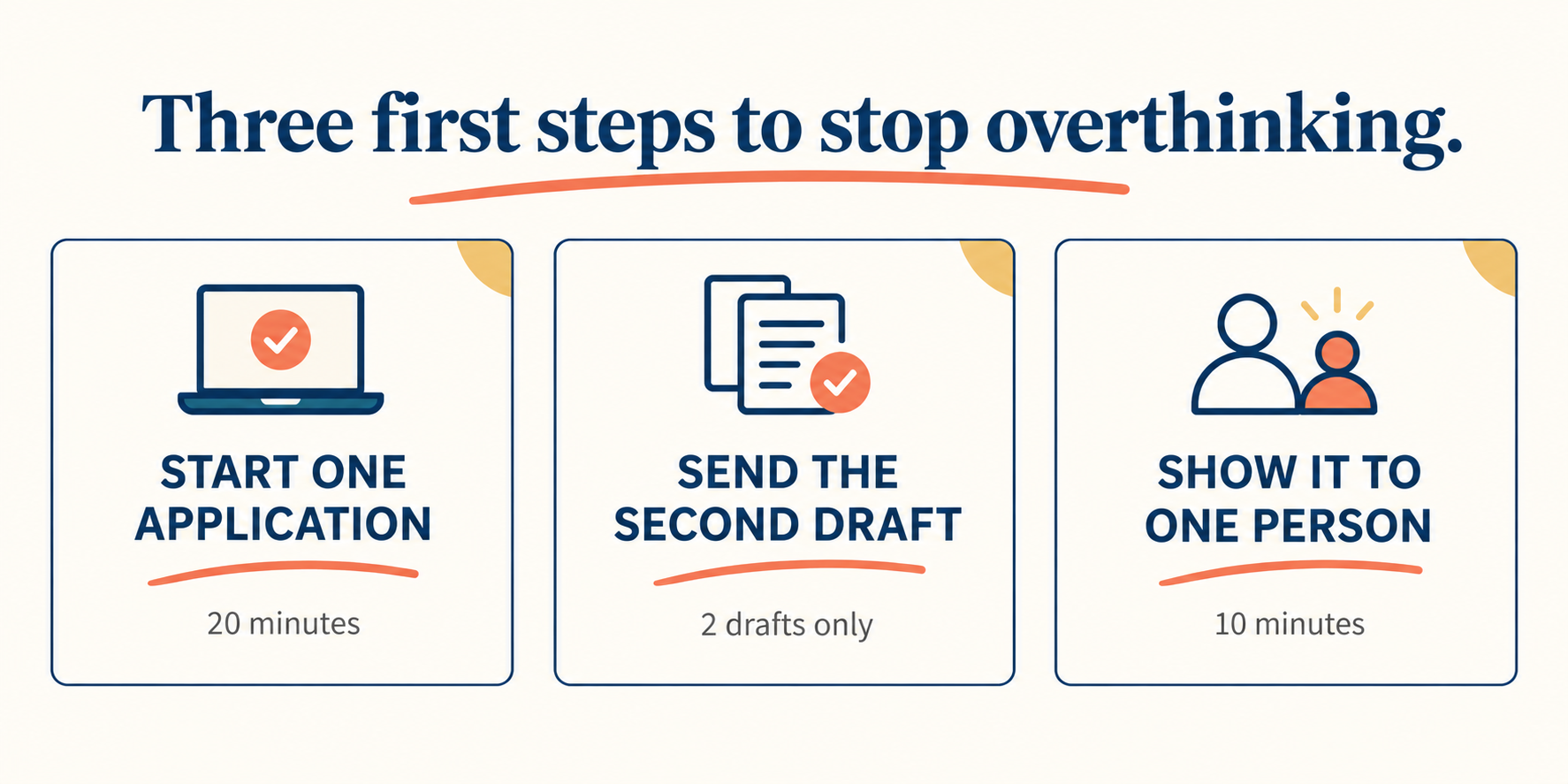
Three small first steps you can copy
Pick the line that matches where you are stuck. Each one has a tiny measure so you know you are done.
Researching jobs but not applying? Open one application and fill in the first section. Metric: 20 minutes, one form started.
Rewriting a message you are afraid to send? Send your second draft. Metric: two drafts, no more.
Polishing an idea nobody has seen? Show it to one person and ask one question. Metric: one person, ten minutes.
FAQs: stopping overthinking
Q: How do I stop overthinking right now? A: Set a ten-minute timer, write the decision in one sentence, and do the smallest step you could undo. Acting before you gather more opinions breaks the loop faster than another list of pros and cons.
Q: What if I take the step and it goes badly? A: A small step is built to be undone. If it misses, you learn what to change and try a smaller version tomorrow. If you stall for a few days, here is how to restart without starting over.
Q: Is overthinking the same as anxiety? A: Not always. Many people overthink now and then. If worry keeps you from sleeping or working most days, talk with a licensed professional. This post is education, not medical advice.
Try this before you close the tab
Which decision have I been replaying the longest?
What is the smallest step on it that I could undo tomorrow?
What time today will I start the ten-minute timer?
If you have a long list of ideas and not one finished, pick one idea and make it a first step works the same way.
Your next step
There’s a full 7-day confidence checklist inside the free guide with step-by-step instructions on how to use it.
Get the guide here: https://bill-limitless.com/free-guide
You do not have to feel ready. You only have to start small, and you can do that today.
I Believe In Your Greatness. Your Path To Limitless Growth!