

You do not need more ideas. You need a way to follow through.
You do not have an idea problem. You have a follow-through problem.
Most people who feel stuck are not short on vision. They have a notebook, a notes app, and a head full of plans. What they lack is a structure that turns one idea into one step they can take today.
You follow through on your ideas when you add three things: a simple structure, someone to report to, and a first step small enough to finish. One reader, Kessie Z., says that mix helped her stop procrastinating and start building momentum. Her story is below, in her own words.
You will see what changed for her, why those changes work, and five steps you can try this week. Being clear about one next step is how personal growth starts to feel possible again.
What does it look like to go from overwhelmed to consistent?
It looks like replacing “I have too many ideas” with “I know my next step.” Here is how Kessie describes the shift.
Case study: Kessie Z.
The honest frame: Kessie was part of a free group I ran, and she shared this feedback afterward. This is one person’s experience, not a promise of results.
The problem. Before the group, Kessie says she struggled with staying consistent to the end. She had many ideas but often felt overwhelmed, which led her to procrastinate instead of taking action. She knew what she wanted to grow into, but did not always have the structure or accountability to follow through.
The action. She joined a group with structure, accountability, and clear guidance, and she practiced taking one step at a time.
The result. In her words: “I’ve become much more consistent and intentional. I’ve learned to take things one step at a time instead of expecting perfection before I start. I feel calmer, more grounded, and more accepting of where I am, while still making meaningful progress.”
She adds that she has been able to move through self-doubt and apply what she learns to real situations in her life.
Why do good ideas stall before you act?
Good ideas stall because overwhelm makes the first step feel too big, and waiting for perfect feels safer than starting. Kessie names it directly: she was expecting perfection before she began.
That pattern is not a lack of discipline. It is a decision problem. When every idea needs a full plan, you spend your energy deciding and have none left for doing. That is the same idea behind needing fewer decisions instead of more willpower.
The fix is not a bigger plan. The fix is a smaller first step that you can finish before the doubt shows up.
What helped her follow through?
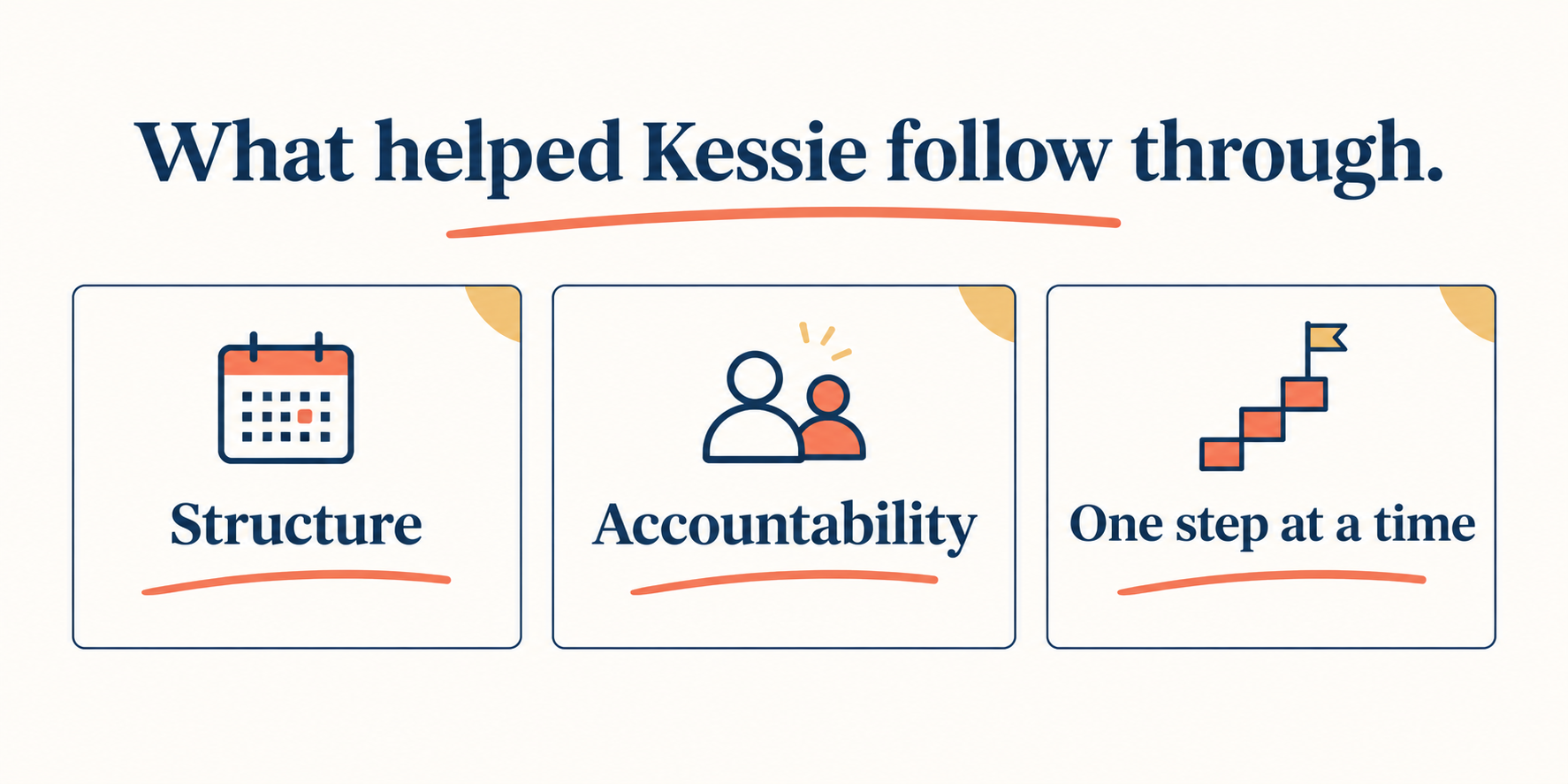
Three things show up in Kessie’s own words: structure, accountability, and one step at a time. Each one removes a different reason people stall.
Structure tells you what to do next, so you stop guessing. Accountability means someone expects an update, so the step gets done. Small steps make starting easy, which builds confidence.
Research backs the small-step idea. A 2006 meta-analysis, which is a review that combines many studies, by psychologists Peter Gollwitzer and Paschal Sheeran covered 94 tests and found that “if X happens, I will do Y” plans helped people reach their goals, with an average effect size of 0.65. “Gollwitzer and Sheeran meta-analysis of implementation intentions.”
How do you build consistency without being perfect?
You build consistency by allowing imperfect days and returning the next day. Missing one day does not erase your progress.
In a University College London study led by Phillippa Lally and published in the European Journal of Social Psychology, a habit took about 66 days on average to feel automatic. Missing a single opportunity did not significantly affect habit formation.
That is good news for anyone who quits after one slip. If you do miss days, restart without starting over and keep going. That kind of reset is resilience, and it matters more than a perfect streak.
How do you start this week in five steps?
You start by shrinking one idea into one action and giving it a time and a witness. The five steps take about ten minutes.
Pick one idea from your list, only one.
Shrink it to a first step you can finish in ten minutes.
Write one plan: “If it is Thursday at 7pm, I will do this step.”
Tell one person what you will do and when.
Check in after three days and name your next step.
FAQs: following through
Q: What if I do not have anyone to hold me accountable?
A: Start with one person you trust and send one short text. Try this: “I am doing this step by Friday. Can I tell you when it is done?” Accountability only needs someone who will notice. Over time, a group or coach can add more structure.
Q: Why do I procrastinate on things I care about?
A: Caring raises the pressure, and pressure makes the first step feel risky. When a step feels big, delay feels safer. Shrinking the step lowers the risk, which makes starting easier. Fresh starts help too, as why September beats January for a fresh start explains.
Q: How long until I feel more consistent?
A: It varies by person. The UCL habit study found an average of about 66 days, with wide differences between people. Focus on the next small step, not the finish line.
Try this before you close the tab
Which one idea am I ready to shrink into a ten-minute step?
Who is the one person I will tell?
When exactly will I do it?
Your next step
There’s a full 7-day confidence checklist inside the free guide with step-by-step instructions on how to use it.
Get the guide here: https://bill-limitless.com/free-guide
You do not have to wait until you feel ready. You only have to take the next small step.
I Believe In Your Greatness. Your Path To Limitless Growth!