
Know what your money is for, and the daily choices get simple
Coffee. Delivery. A subscription. A weekend trip. None of these feels big. Together, they decide where your paycheck goes.
If every small purchase feels like a fight, the problem is not self-control. You are missing a reason.
A money vision is one plain sentence about what your money is for, and it turns daily spending choices into quick yes or no answers. Reasons work. In a study of bank customers in Peru, people who got reminders that named their own reason for saving saved 16% more than people who got no reminder. Karlan and colleagues’ savings reminder study
Below, you will see why a clear reason beats willpower, how to write yours in five minutes, and three lines to say before you buy. Being clear about what your money is for builds financial confidence, and it is personal growth you can use today.
What is a money vision, and how is it different from a budget?
A money vision is one sentence about the life your money is meant to pay for. It is not a number, and it is not a spreadsheet. A budget, which is a plan for how much you can spend in each category, tells you what you can spend. A vision tells you why you care.
Here is an example: “My money buys me a calm life, with no panic when something breaks.”
Think of your vision as a filter. When a purchase passes through it, you buy with a clear head. When it does not, the choice gets easier too. You stop debating every dollar and start answering one question.
Why does a clear reason make spending decisions easier?
A clear reason makes spending easier because it replaces a hundred small debates with one. Without a reason, each purchase is a new negotiation, and tired people lose negotiations with themselves.
The research points the same way. In the Peru study by Dean Karlan and his team, reminders that mentioned a person’s own reason for saving worked. Generic reminders had no significant effect. Across all three countries studied, clients who got reminders saved 6% more and were 3 percentage points more likely to reach their savings goal.
Seeing a real reason also helps. In experiments led by Hal Hershfield, people shown age-progressed pictures of themselves put about 33% more into retirement accounts in the study task (Journal of Marketing Research, 2011). Hershfield’s future self research
When the future feels real, today’s choice gets lighter. That is why tracking every dollar is not the fix on its own. Tracking tells you what happened. A vision tells you what to do next.
How do you write your money vision in five minutes?
You write your money vision by finishing one sentence and putting it where you spend. You need your phone and about five minutes. No number is needed.
Think about one thing you want your money to give you a year from now. Think in feelings, like calm, freedom, safety, or choices.
Finish this sentence: “I want my money to help me ______.”
Cut it to 15 words or fewer.
Save it as your lock screen or a note in your banking app.
Read it before one purchase today.
If you are about to get your first paycheck, give it a job before it lands and let your vision name that job.
A few examples: “My money buys me freedom to say no to a job I hate.” Or: “My money keeps me safe, so a bad month is just a bad month.” Or: “My money pays for trips with people I love.” Pick words that sound like you, not like a textbook.
Your vision can change as your life changes. That is normal, and it is part of building resilience with money.
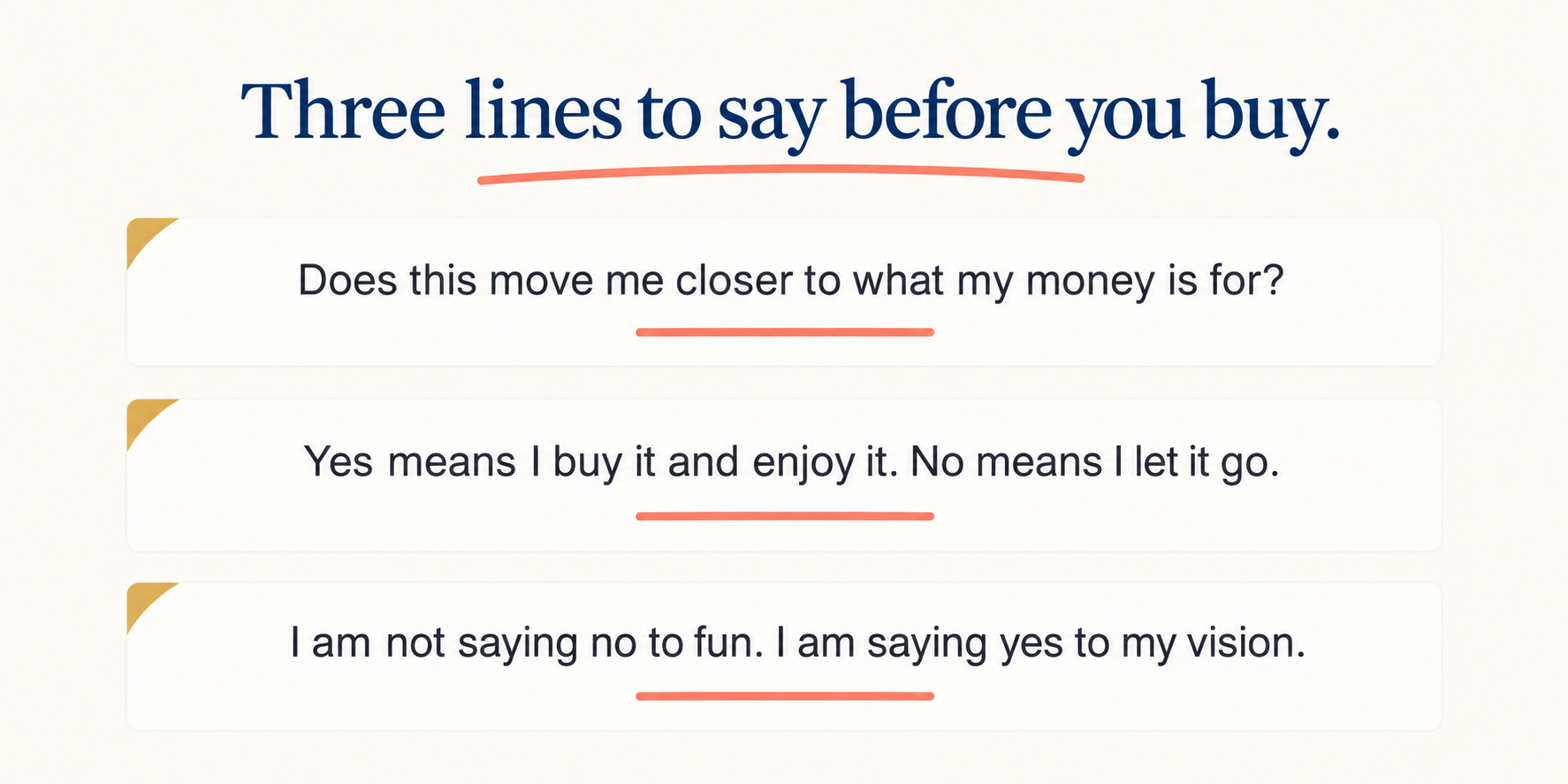
Three lines to say before you buy
Use these in the moment before a purchase. Each one is short enough to say in your head at the register or at checkout.
“Does this move me closer to what my money is for?”
“Yes means I buy it and enjoy it. No means I let it go.”
“I am not saying no to fun. I am saying yes to my vision.”
Say the lines once. Notice how the choice feels afterward. That small win is how momentum starts with money.
FAQs: your money vision
Q: Does a money vision mean I can never spend on fun? A: No. Fun can be part of your vision. A trip with friends can fit “a life with room to enjoy it.” The point is to spend on purpose, so you enjoy it without guilt.
Q: What if I do not know what I want my money to do yet? A: Start with a feeling. Ask whether you want more calm, more freedom, more safety, or more choices. Pick the one that matters most this month, write it down, and change it later if it stops fitting.
Q: Do I need a budgeting app to use a money vision? A: No. A sentence on your phone is enough to start. Apps can help later, but a clear reason helps you act on what the app shows. Buy now pay later checkouts are a good test, as buy now pay later debt shows.
Try this before you close the tab
What do I want my money to give me a year from now?
Where will I see my vision before I spend?
Which purchase this week will I check against it first?
Your next step
Inside the free guide, you set up your first paycheck so it has a job before it lands, in about ten minutes a step.
This post is financial education, not financial advice. Every money decision is your own.
You do not need a perfect plan. You need a reason you can say out loud.
I Believe In Your Greatness. Your Path To Limitless Growth!