
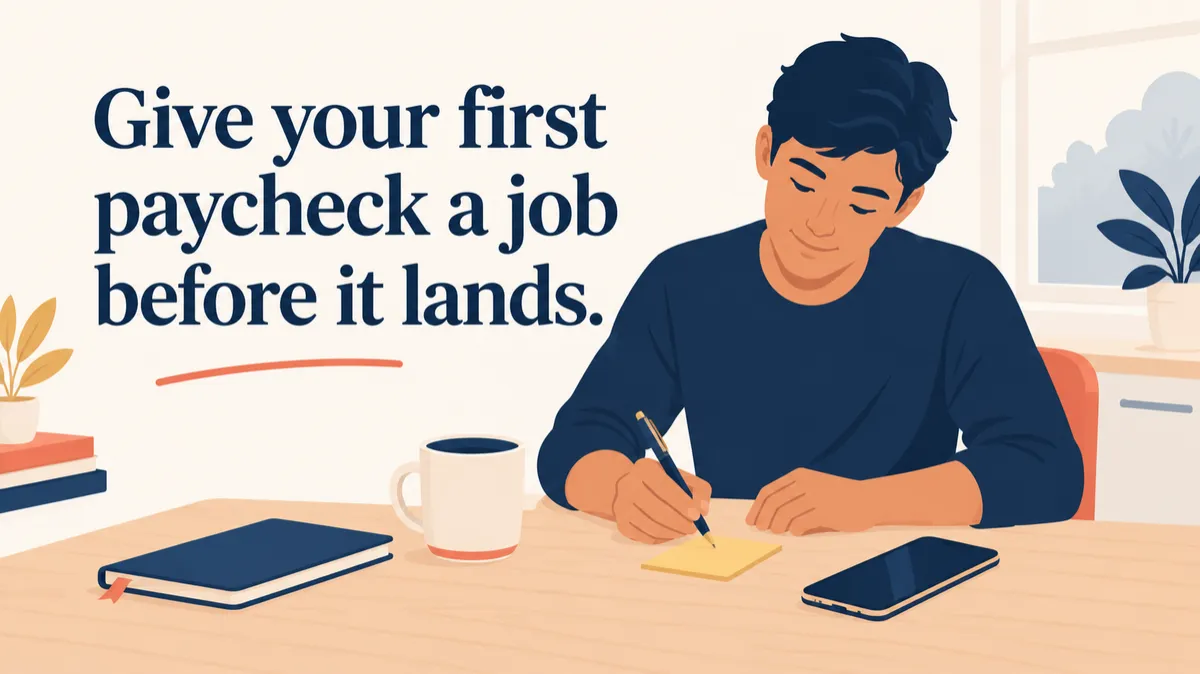
Give your first paycheck a job before it lands
Your first paycheck is not the problem. The three months after it are.
Most new grads and new hires do the same thing. The money lands, life starts spending it, and by the end of the quarter they are asking where it all went. That is not a character flaw. It is what happens when no one gave the money a job.
Giving your first paycheck a job means choosing, before payday, the one thing it must do for you. This matters because 42% of Gen Z adults say they live paycheck to paycheck, according to Bank of America’s 2026 survey.
Below, you will see why money disappears, how to give it a job in five minutes, and a three-line note you can copy tonight. Being clear about one paycheck builds the money vision and the confidence that every later choice rests on.
Why does your first paycheck disappear so fast?
Your first paycheck disappears because every small purchase gets decided on its own, and no bigger purpose stands in the way. Five dollars here, a subscription there, a buy now pay later checkout that never feels like debt.
Researchers call part of this present bias, which is the habit of choosing what feels good today over what helps you later. In a field experiment in Afghanistan, Joshua Blumenstock, Michael Callen, and Tarek Ghani found that default enrollment in automatic payroll savings raised saving rates by 40 percentage points. They traced much of that effect to procrastination. (National Bureau of Economic Research field experiment.)
People often skip saving not because they do not care, but because the decision never gets made. That is the same idea behind needing fewer decisions instead of more willpower.
What does it mean to give your first paycheck a job?
A job for your paycheck is one clear purpose you choose before payday, like covering your first bill or starting a small cushion. It changes the question from “what do I feel like buying” to “what is this money for.”
Think of it like hiring. You would not bring someone onto a team without a role, and money works the same way. When your money has a role, every purchase gets measured against your vision for it. Being clear on that role is the first step in personal development with money.
I got laid off four times, and every layoff taught me the same lesson: when you do not control your money, life makes your decisions for you. Your first paycheck is the cleanest place to start, because no old habits are attached to it yet.
How do you give your first paycheck a job in five minutes?
You give your first paycheck a job with five short steps and one small note. You need your phone and about five minutes.
Find the date your first paycheck lands, using your offer letter or by asking HR.
Write the one thing that paycheck must do for you.
Name the first bill it will cover.
Put your note where you will see it before payday, like your phone lock screen.
Check the note on payday, before you spend anything.
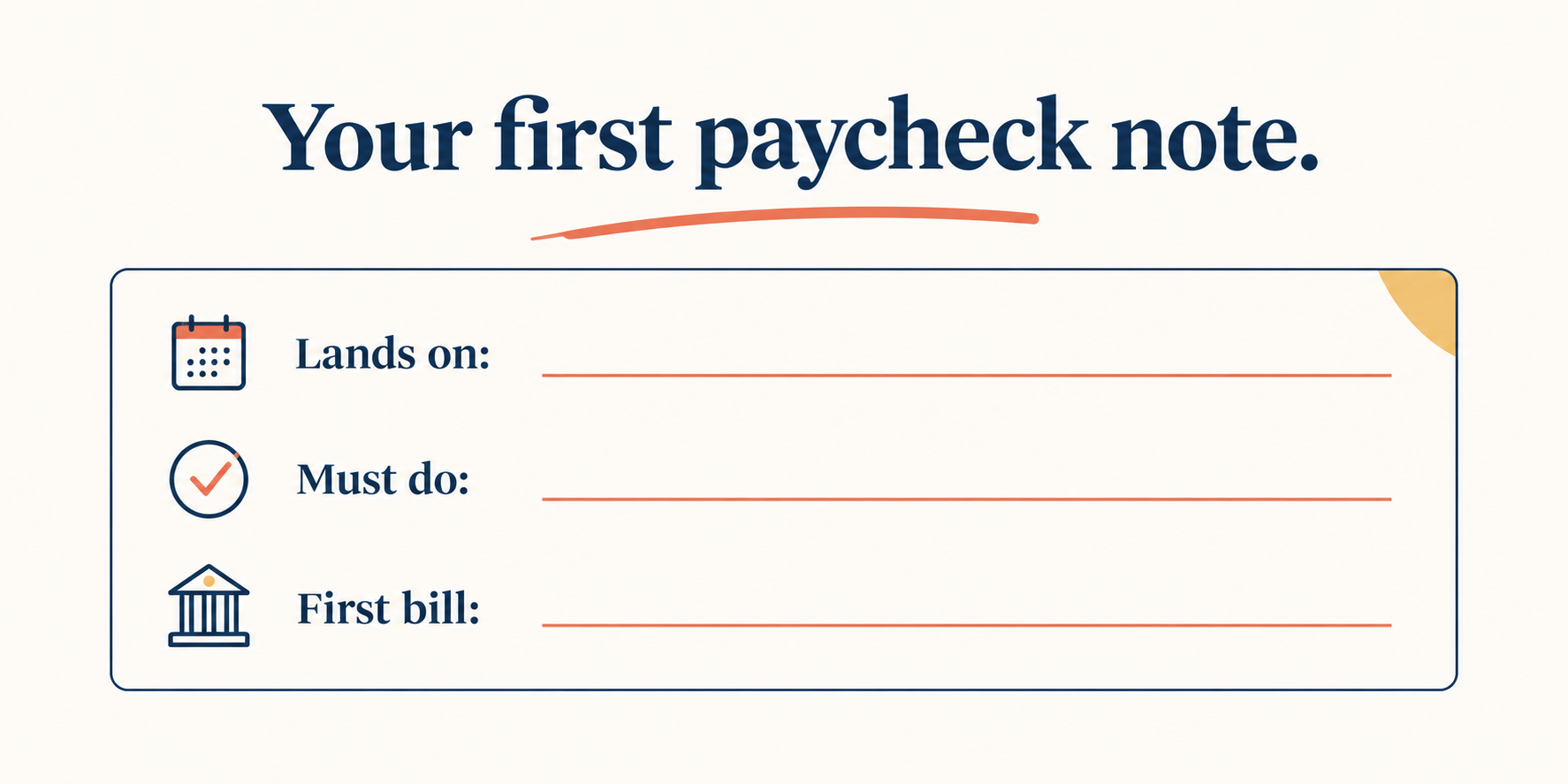
Copy this: your first paycheck note
My first paycheck lands on: ______
The one thing it must do: ______
The first bill it covers: ______
Example: Lands on the 15th. Must do: cover my phone and my transit pass. First bill: my phone bill.
Keep it to three lines. If it needs a fourth, the job is too big.
What changes when your paycheck has a job?
When your paycheck has a job, spending decisions get simpler and the guilt gets smaller. You stop asking whether you can afford something in the moment. You start asking whether it fits the job, which is a faster and calmer question.
This is how momentum starts with money. One clear purpose, one small win on payday, and you have proof that you can follow through. That proof is personal growth you can see, and it builds the confidence for your next step. It also builds the resilience to reset when a month goes sideways.
A clear job also protects you from surprises. The Federal Reserve’s Economic Well-Being of U.S. Households in 2025 report, released in May 2026, found that 63% of adults could cover a $400 emergency expense with cash or its equivalent. That leaves more than a third who could not.
FAQs: your first paycheck
Q: What if my first paycheck is smaller than I expected?
A: Write the note with the number you actually receive, not the number you hoped for. Your pay stub, the statement that shows what was taken out for taxes and benefits, lists your take-home pay. A smaller number makes the one job clearer, not less important.
Q: Do I need a budgeting app to plan my first paycheck?
A: No. One three-line note is enough to start. A tool can help later, but a clear purpose on payday matters more than the app. Tracking every dollar alone does not fix the problem either, as “why tracking every expense is not the fix.
Q: What if I already spent my first paycheck without a plan?
A: Use your next one. The note works on any paycheck, and the lesson still counts. If you slip, restart without starting over, on the very next payday.
Q: Is this financial advice?
A: No. This post is financial education, not financial advice. Every money decision is your own.
Try this before you close the tab
What is the one thing my next paycheck must do?
Which bill comes first?
Where will I see my note on payday?
Your next step
Inside the free guide, you set up your first paycheck so it has a job before it lands, in about ten minutes a step.
Get the guide here: https://bill-limitless.com/free-moneymoves-guide
This post is financial education, not financial advice. Every money decision is your own.
You do not need a perfect plan. You need one clear purpose and the courage to write it down.
I Believe In Your Greatness. Your Path To Limitless Growth!